THE YEARLY READER
2025: Prop Guns
Baseball’s profit-driven embracement of the sports betting industry once again exposes itself to the perils of game fixing.
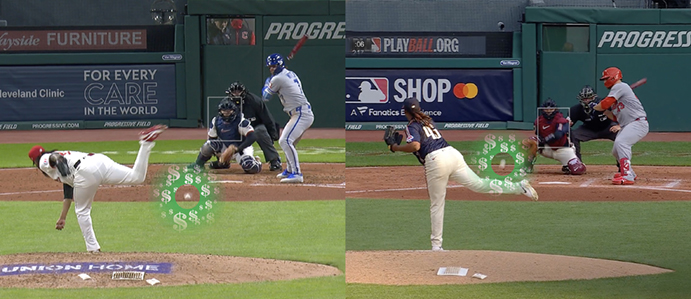
Way outside, and right on target: These two pitches thrown by Cleveland pitchers Emmanuel Clase (left) and Luis Ortiz were nowhere near the strike zone—yet they were thrown intentionally outside to help bettors win tens of thousands of dollars. (CLEG)
Emmanuel Clase reigned through the first five years of the 2020s as the premier closer of Major League Baseball. No other closer during this time had more saves, nor a better earned run average. His fastball topped out at 101 MPH, with a slider that impressively reached 93. He was par excellence among ninth-inning relievers.
Yet late in 2025, the Cleveland Guardians’ right-hander found himself facing his toughest save assignment yet: That of his own career.
With starting pitching teammate Luis Ortiz in tow, Clase became part of baseball’s biggest gambling scandal in a brave and dangerous new world where legalized sports betting, online or otherwise, was bound to lead to troubling outcomes. For Clase and Ortiz, one of those outcomes would be the fateful reality of never throwing another pitch in a professional baseball game.
The scourge of gambling and bribery within baseball has hardly been restricted to well-known scandals, such as the dumping of the 1919 World Series by Chicago White Sox players, or manager Pete Rose’s rampant betting on his Cincinnati Reds during the late 1980s. Ever since the sport’s very first pitch in the 19th Century, baseball players have been periodically tempted and tainted. In the National League’s second season of 1877, members of the Louisville Grays threw away first place in the waning weeks for outside money. During the 20th Century’s first two decades, players left and right were suspended or outright banned for accepting cash in exchange for fixing game outcomes. Even after Kenesaw Mountain Landis, the game’s first modern commissioner, supposedly scared everyone straight from even considering a bet or bribe, baseball was still wary enough of its corruptive past that it temporarily banned retired legends Willie Mays and Mickey Mantle from the sport simply for serving as official greeters at an Atlantic City casino.
MLB’s attitude toward gambling underwent an about face starting in 2018, after the U.S. Supreme Court struck down a federal law barring sports betting—declaring that it was up to the states to decide. Right on cue, the number of states allowing sports betting went from one (Nevada) to 38, with 30 of those giving the nod to online wagering. As the proliferation of gambling mushroomed—with $1 billion per day on average spent on bets—so did the number of people who became addicted to it, often resulting in personal bankruptcies.
Along with the other major pro sports leagues, MLB—which initially backed the preservation of the federal gaming law—decided that if you can’t beat ‘em, join ‘em. Almost immediately, MLB buddied up with the betting industry, creating lucrative sponsorships with the likes of FanDuel, DraftKings and BetMGM, held awards shows on the Las Vegas Strip, and allowed sportsbooks to be opened outside—and inside—major league ballparks. The Black Sox would have been envious.
All too predictably, a dark underbelly would be exposed below the newfound riches. In 2024, five fringe or minor league ballplayers, an umpire (Pat Hoberg) and the translator for megastar Shohei Ohtani all received various forms of punishment for direct or indirect activity betting on MLB games. More honest players increasingly became targets of failing bettors who, fueled by a toxic mix of anger, social media and sometimes alcohol, fired off hostile posts or texts, in some cases threatening not just the players they lost money on, but their families.
BTW: Of the five ballplayers punished, only one—San Diego’s Tucupita Marcano—received a lifetime ban for betting on his own team while recovering from a torn ACL
While suspensions, banishments and even prison time were handed out upon those caught up in the gambling, Emmanuel Clase carried on unnoticed, as he had since the early weeks of the 2023 season. It was about at this time, according to the federal indictment against him, that the Cleveland closer initiated a scheme to give inside information to a bettor—a friend or associate—that he would intentionally miss the strike zone with his first pitch, or that it would be either slower or faster than a certain velocity. The bettor would place the wager and pass the info on to other befriended bettors who did the same. This was not about fixing an entire game, but a single pitch—jargon known in the sports betting world as a prop bet.
Harmless as one intentional miss might be in the minds of many, profound consequences could still follow. In the first game Clase was said to be involved in the scheme, he blew a two-run, 10th-inning lead and the game against the New York Mets. More concerning, a wild delivery—intentional or not—could cause harm for the catcher blocking it, as happened to Cleveland’s Mike Zunino on a tainted Clase delivery during a June 2023 game at Minnesota.
In 2025, Clase got greedier—and more active. Having charitably enriched his bettors with tens of thousands of dollars, Clase began demanding a cut of the action. The bettors, feeling more emboldened, began combining their prop bets into parlays, multiple wagers with higher odds but bigger payouts that were certain to follow since Clase was telling them what to expect. On occasion, the heads-up from Clase would come in the form of a text or even a phone call, sometimes minutes before he began warming up. Using a mobile phone during a game violated MLB rules, but what the heck—Clase was already breaking baseball’s most sacred commandment: Thou shall not bet on his own ballgame.
BTW: Not every prop bet guaranteed by Clase for his betting buddies went according to plan. In a May 28 game, Clase’s first pitch, thrown intentionally in the dirt, was swung at and missed by the Los Angeles Dodgers’ Andy Pages—resulting in Clase’s bettors to lose out on a parlay.
By June, Luis Ortiz joined in on the hustle. A fellow Dominican Republic-born pitcher, the 26-year-old Ortiz had been picked up by the Guardians before the season from Pittsburgh, where he showed improvement as a starter. But early on with Cleveland, Ortiz’s control was an issue, walking nearly five batters every nine innings he pitched. So, it didn’t seem odd when Ortiz’s first pitch of the second inning at Seattle on June 15 badly missed the plate—as well as his first pitch of the third inning 12 days later against St. Louis. The feds claimed that the errant throws were intentional, grossing $63,000 for those nefariously in the know. Not only did the bettors clean up, so did the Mariners—who scored five times off Ortiz in that second inning—and the Cardinals, who rallied for three in that third. For facilitating the fixes, Clase and Ortiz each earned $12,000 in kickback commissions.
The more brazen the participants became, the more they pressed their luck. That luck ran out when a betting integrity firm, in business to monitor suspect activity, noticed the unusually large spikes in cash wagered on the prop bets related to Ortiz and reported it to MLB, which went into investigative mode. Hours before his next scheduled start on July 3, Ortiz was placed on indefinite paid leave by a very wary MLB. A month later, it paused Clase as well.
Neither player would pitch again for the rest of the season.
The absences of Ortiz and (especially) Clase were considered the death knell for Cleveland’s already remote chances of making the postseason. On July 28, the day Clase joined Ortiz in being forcibly sidelined, the Guardians were two games below the .500 mark and a mile behind first-place Detroit, running away with the American League’s Central Division thanks in no small part to another brilliant, Cy Young Award-winning campaign for ace Tarik Skubal (13-6, AL-best 2.21 ERA). But the Guardians, even without Clase, went a surprising 36-20 down the stretch—while the Tigers, after holding the fort well through August, collapsed in September—losing 13 of their last 16 games and, during the last week, the divisional lead.
Detroit still had a shot at winning the division on the season’s last day, but Tigers manager A.J. Hinch had to think about whether it was more important to start Skubal for that last game, or preserve him for the opening contest of the Wild Card Series—with Cleveland being the likely opponent. Hinch embraced the latter option, essentially sacrificing the AL Central title and home-field advantage in that first-round set against the Guardians.
Hinch’s risky strategy paid off. Skubal started Game One, allowing a run over 7.2 innings with a career-high 14 strikeouts, and the Tigers won the all-important opener, 2-1. The Guardians, needing to win the next two games, secured Game Two—but the bullpen, minus Clase, collapsed in Game Three, allowing five runs over the final four frames as the Tigers advanced.
Skubal retained his excellence in the second-round AL Divisional Series against Seattle, which won its first AL West title in 24 years behind a remarkable 60-home run campaign from catcher Cal Raleigh. In his two starts against the Mariners, Skubal struck out 22 batters—including seven straight in a winner-take-all Game Five to set a postseason record—walked just one, and allowed three runs over 13 innings. But he didn’t get the win in either start, as Detroit hitters struggled to support him. Skubal was long gone by the time the Mariners, in the bottom of the 15th in Game Five, captured the series on Jorge Polanco’s one-out, bases-loaded single through the infield.
For the Mariners—the only remaining MLB team yet to win a pennant—the road to their first World Series had to go through Toronto and the Blue Jays, looking to make their first Fall Classic appearance in 32 years.
The Blue Jays were the surprise of the AL, bouncing back from a last-place finish in the AL East the year before to, in 2025, a share of the league’s best record with New York, snagging first-place rights by virtue of a better head-to-head record against the Yankees. Fueling the Blue Jays’ rebound was a return to form for shortstop Bo Bichette (.311 batting average, 18 home runs, 94 RBIs) and outfielder George Springer (.309, 32, 84), with an evolving support ensemble of third baseman Addison Barger, infielder Ernie Clement and outfielder Nathan Lukes further solidifying the base. But the team’s headliner remained Vladimir Guerrero Jr., a pending free agent on Opening Day—and, a week later, the recipient of a 14-year, $500 million extension. Though Guerrero’s 2025 numbers were, by his standards, mild (.292 average, 23 homers and 84 RBIs), his bat showed signs of an October surge in Toronto’s four-game ALDS defeat of the Yankees, with the first three of eight homers he would crush in the postseason.
Against the Blue Jays, the Mariners would prove defiant, winning the first two games of the AL Championship Series at Toronto. Although the Jays won two of the next three contests at Seattle, they returned to Rogers Centre needing to win both the sixth and seventh games—and possibly doing so without Springer, who was plunked on the kneecap in Game Five to the cheers of Seattle fans, perhaps recalling his role in the Houston Astros’ dishonest 2017 world title. X-rays showed no serious damage to Springer, who managed to hobble as a DH through a hitless Game Six as Toronto stayed alive with a 6-2 win. But in Game Seven, Springer became the hero with a three-run homer in the seventh, turning a 3-1 Toronto deficit into a 4-3 lead that would hold to the end and give the Blue Jays the AL flag. Cal Raleigh’s four ALCS homers—giving him 65 for the year, including the postseason—were not enough for the Mariners, who remained historically shut out of the World Series.
BTW: Springer’s Game Seven homer resulted in one of three comeback ALCS wins for the Blue Jays—adding to the team’s MLB-leading 49 during the regular season. It underscored the resilience of an offense that frequently had to bail out an average-at-best pitching staff.
The Blue Jays’ opponent at the World Series would be, but of course, the Los Angeles Dodgers—virtually everyone’s pick to win it all before the season’s first game, remaining so after the 162nd despite being slotted as the third seed in the National League’s playoff bracket.
Dodgers management hardly rested following the team’s 2024 championship season. They snared a top ace (two-time Cy Young Award winner Blake Snell), the offseason’s two hottest available Asian stars (23-year-old Japanese pitcher Roki Sasaki and Korean infielder Hyeseong Kim) and two of the top free-agent relievers (Tanner Scott and Kirby Yates). Some people jokingly boasted that the Dodgers, featuring five players with MVP/Cy Young credentials, 15 with All-Star Game acceptance, and arguably the majors’ best farm system, had become a juggernaut worthy of a 162-0 season. And when Los Angeles won its first eight games of 2025—the best start from a reigning World Series champ since the 1933 Yankees—that boast seemed more rooted in reality.
Immortality soon gave way to commonality—and then morbidity. From the Fourth of July through the first week of September, the Dodgers toiled through a 22-32 stretch, batting only .234 as a team while watching a nine-game lead in the NL West shrink to, briefly, nothing. Sometimes, the Dodgers went completely off the rails—suffering their two worst losses in Dodger Stadium history, 16-0 to the Chicago Cubs and 18-1 to the Astros. When the games were closer, the leads couldn’t be held, as Scott racked up an MLB-high 10 blown saves while fellow reliever Blake Treinen was charged with a loss in each of five straight Dodger defeats. But down the stretch, Los Angeles snapped out its midsummer funk and rebounded to cement its 12th divisional title in 13 years.
Despite the unexpected warts, the Dodgers still impressed on the stat sheet. Not surprisingly, Shohei Ohtani led the way, continuing to perform not so much as a mere superstar but more a member of the Marvel Multiverse. His 55 home runs clipped the Dodgers record he himself set a year earlier, while his MLB-leading 146 runs set another post-1900 franchise mark. Oh, and he was pitching again; his throwing arm healed by June, Ohtani made 14 appearances, each one a little longer than the previous—from one inning in his first outing to six in his last—posting a 2.87 ERA.
In a case of perfect timing, the Dodgers were virtually 100% healthy in time to start the playoffs. This included a full hand of aces on the mound that collectively missed over 10 months of action during the regular season: Ohtani, fellow Japanese import Yoshinobu Yamamoto, Snell, Tyler Glasnow, and Clayton Kershaw—concluding his Hall-of-Fame career with an 11-2 record and 3.36 ERA in limited play.
After taking care of the young, we’re-just-happy-to-be-here Cincinnati Reds (83-79) in an easy two-game Wild Card Series sweep at Los Angeles, the Dodgers faced home field disadvantage for the rest of the NL playoffs against a pair of excellent opponents: The veteran, equally star-studded Philadelphia Phillies in the NLDS, followed in the NLCS with the electric, overachieving Milwaukee Brewers, sporting the majors’ best (97-65) record and a spendthrift payroll some $40 million less than the Dodgers’ luxury tax. Los Angeles mowed down both teams, winning seven of eight total games—including all four on the road.
The most memorable takeaway from the Dodgers’ fifth NL pennant in nine years was Ohtani’s two-way masterclass in the NLCS clincher against the Brewers. On the mound, he allowed two hits with 10 strikeouts over six shutout innings while, at the plate, he crushed three home runs—the second of which being a 469-foot clout that cleared the Dodger Stadium bleachers and bounced through the concourse beyond.
Both league championship series experienced no shortage of remarkable performances and thrilling outcomes. But for the World Series, both the Dodgers and Blue Jays were ready to say, “Hold my energy drink.”
In Game One at Toronto, the Blue Jays scored all 11 of their runs over the middle three innings in an 11-4 thrashing. A night later in Game Two, Yamamoto clamped down on the Jays, 5-1, for his second straight complete-game victory—something no pitcher had done in a single postseason since Curt Schilling in 2001.
Then came Game Three at Los Angeles. Ohtani, running hot and cold throughout October, got white hot again; he collected extra-base hits (two homers, two doubles) over his four first at-bats, knocking in all five Dodgers runs through the eighth inning. When Ohtani came back to bat again in the ninth with the game tied, Toronto manager John Schneider wanted nothing more to do with him—intentionally walking Ohtani with one out and no one on base. Schnieder would give Ohtani another free pass in the 11th—and the 13th, the 15th, and the 17th (this one not officially intentional, with Toronto reliever Brendon Little purposely giving him nothing good to hit) as the game continued well into the Southland night. Finally, in the bottom of the 18th, Freddie Freeman ripped a solo home run off Little to ice a 6-5 victory.
Here We Go Again
The Dodgers’ 18-inning, 6-5 victory over Toronto in World Series Game Three drew instant comparisons to the third game of the 2018 World Series—which the Dodgers also won in 18 frames on a walk-off home run (that time, by Max Muncy). It also set or tied a bunch of records. Game Three tied for the longest postseason contest by innings; both teams left more men on base (19 for Toronto, 18 for Los Angeles) than in any other World Series game before it; and Shohei Ohtani tied an all-time mark—regular season or post—by reaching base nine times, with five walks equaling a postseason record, and the four intentional passes setting another. Finally, Game Three will be remembered for Clayton Kershaw’s last appearance, facing just one batter; in an eight-pitch at-bat against Toronto’s Nathan Lukes, Kershaw ultimately induced an ending-inning, bases-loaded double play to get the Dodgers out of a 12th-inning jam.
As they had throughout the season, the Blue Jays bounced back—winning Games Four and Five at Los Angeles, the latter on an outstanding start for Trey Yesavage (seven shutout innings, 12 strikeouts, no walks), just six weeks removed from his major league debut after beginning the season in Class-A ball. With two games to win one and the championship back in Toronto, the Blue Jays fell in Game Six once more to Yamamoto, who surrendered but a run over six innings in a 3-1 victory.
That set up Game Seven—a duel that would prove to be one for the ages.
Ohtani got the start on the mound for the Dodgers, but he did not have his A-game—surrendering a three-run homer to Bo Bichette that got him knocked out of the box before the end of the third inning. Max Scherzer, older (41) and crankier than ever, faired modestly better as the Toronto starter, leaving the game midway through the fifth with a 3-1 lead.
Trailing 4-2 in the eighth, the Dodgers pecked away with the long ball. A Max Muncy solo blast off Yesavage (pitching in relief) narrowed the lead to one. An inning later, with Los Angeles two outs away from defeat against closer Jeff Hoffman, bench player Miguel Rojas—given the rare start even after hurting his shoulder celebrating the previous night’s win—stunned the raucous Rogers Centre gathering with a solo homer of his own to tie the game.
In the bottom of the ninth, the Blue Jays came inchingly close, twice, to winning the series. They loaded the bases with one out off of Snell and Yamamoto, rotation guys performing essential relief in place of an unreliable Dodgers pen. Daulton Varsho next bounced a grounder to a drawn-in Rojas, who threw home for what appeared to be a routine force on pinch-runner Isiah Kiner-Falefa—except catcher Will Smith had his foot hovering over the plate. A video review confirmed that Smith eventually planted that foot down with Kiner-Falefa’s sliding cleat literally an inch away from touching home.
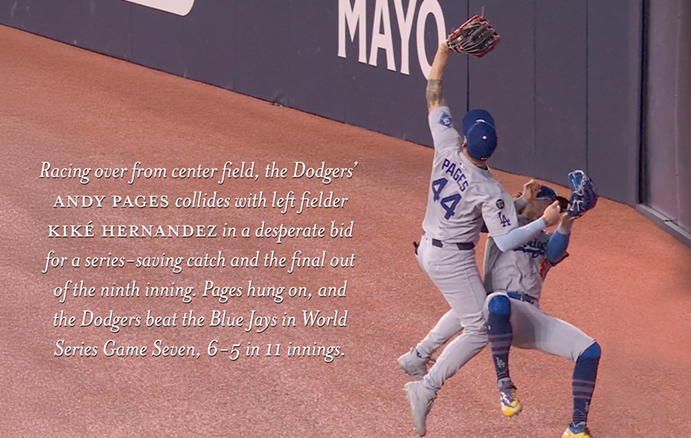
After another walk reloaded the bases, Ernie Clement launched a deep fly to left. Kiké Hernandez tracked the ball at a slightly twisting angle all the way to the warning track—where he suddenly was crashed into by Andy Pages, just inserted into the game and racing 40 yards from his spot in center. Flattened face down, Hernandez was convinced that the collision had led to a dropped ball and a Blue Jays championship—but Pages hung on to send the game into extra innings.
After failing to plate a run in the 10th with a bases-loaded, small-ball rally, the Dodgers needed just one swing in the 11th—another solo homer, this one off the bat of Smith—to put them ahead for the first time in the game. In response, the Blue Jays netted a leadoff double off Yamamoto from Vladimir Guerrero Jr., who moved to third after a sacrifice bunt and walk. With one out, Alejandro Kirk sent a bat-shattering grounder to Mookie Betts at second, who easily turned a game-winning double play and making the Dodgers the first repeat champions since the Yankees of 1998-2000.
BTW: The 2025 World Series, and the postseason before it, saw a significant boost in TV viewership across all platforms. Encouragingly, younger viewers were tuning in at a much higher rate, once again putting to rest the tiresome notion that baseball was dying. Game Seven itself attracted as many as 31 million viewers across America, with 18 million Canadians—representing nearly half of the nation’s population—and 12 million people in Japan, home of Ohtani and Yamamoto, also watching.
A week after the end of the World Series, Emmanuel Clase and Luis Ortiz were indicted by the Department of Justice for bribery, money laundering and conspiracy to influence sporting contests. Denied by the Cleveland Guardians to pitch winter ball in Venezuela, Clase flew back to the States, was promptly arrested at the airport, and along with Ortiz pled not guilty to the charges. They would both be set free on bail and surrendered their passports, as a trial awaited them the following spring.
In kneejerk fashion, MLB huddled with their sports betting partners, who limited prop bet wagers to no more than $200, while eliminating such bets from being included in parlays.
Two ballplayers who each generated little over $10,000 while making far more in salary—Clase’s contract with the Guardians called for $26.4 million in guaranteed wages over the next three years—illustrated the threat of how even seemingly innocuous bets could lead to massive consequences, on the field and off it. Despite online monitoring of suspicious activity—which helped to expose the Clase-Ortiz pitch fixing—MLB went into the offseason pondering whether this case was an outlier, or the tip of the iceberg.
The case of Clase and Ortiz was hardly baseball’s first gambling-related headache.
It was not likely to be its last.
 Forward to 2024: Best of Sho The incomparable Shohei Ohtani joins the Los Angeles Dodgers, injecting strength and promise into their elusive championship ambitions.
 2025 Leaders & Honors Our list of baseball’s top 10 hitters and pitchers in both the American League and National League for the 2025 baseball season, as well as the awards and honors given to the game’s top achievers of the year.
 The 2020s: The Turbulent Twenties Intended changes and unexpected disruption mark a time when Baseball attempts to appeal to a bigger audience, risking the loyalty of its most ardent followers. But an impressive influx of talented young players hopes to rescue the era and keep everyone happy.
2025 Standings
| National League East | ||||
|---|---|---|---|---|
| Philadelphia Phillies | 96 |
66 |
.593 |
--- |
| New York Mets | 83 |
79 |
.512 |
13 |
| Miami Marlins | 79 |
83 |
.488 |
17 |
| Atlanta Braves | 76 |
86 |
.469 |
20 |
| Washington Nationals | 66 |
96 |
.407 |
30 |
| National League Central | ||||
| Milwaukee Brewers | 97 |
65 |
.568 |
--- |
| Chicago Cubs (w) | 92 |
70 |
.568 |
5 |
| Cincinnati Reds (w) | 83 |
79 |
.512 |
14 |
| St. Louis Cardinals | 78 |
84 |
.481 |
19 |
| Pittsburgh Pirates | 71 |
91 |
.438 |
26 |
| National League West | ||||
| Los Angeles Dodgers | 93 |
69 |
.574 |
--- |
| San Diego Padres (w) | 90 |
72 |
.556 |
3 |
| San Francisco Giants | 81 |
81 |
.500 |
13 |
| Arizona Diamondbacks | 80 |
82 |
.494 |
14 |
| Colorado Rockies | 43 |
119 |
.265 |
50 |
| American League East | ||||
| Toronto Blue Jays | 94 |
68 |
.580 |
--- |
| New York Yankees (w) | 94 |
68 |
.580 |
--- |
| Boston Red Sox (w) | 89 |
73 |
.549 |
5 |
| Tampa Bay Rays | 77 |
85 |
.475 |
17 |
| Baltimore Orioles | 75 |
87 |
.463 |
19 |
| American League Central | ||||
| Cleveland Guardians | 88 |
74 |
.543 |
--- |
| Detroit Tigers (w) | 87 |
75 |
.537 |
1 |
| Kansas City Royals | 82 |
80 |
.506 |
8 |
| Minnesota Twins | 70 |
92 |
.432 |
18 |
| Chicago White Sox | 60 |
102 |
.370 |
28 |
| American League West | ||||
| Seattle Mariners | 90 |
72 |
.556 |
--- |
| Houston Astros | 87 |
75 |
.537 |
3 |
| Texas Rangers | 81 |
81 |
.500 |
9 |
| Athletics | 76 |
86 |
.469 |
14 |
| Los Angeles Angels | 72 |
90 |
.444 |
18 |
2025 Postseason Results
NL Wild Card Series
Los Angeles defeated Cincinnati, 2-0.
Chicago defeated San Diego, 2-1.
AL Wild Card Series
New York defeated Boston, 2-1.
Detroit defeated Cleveland, 2-1.
NLDS
Milwaukee defeated Chicago, 3-2.
Los Angeles defeated Philadelphia, 3-1.
ALDS
Seattle defeated Detroit, 3-2.
Toronto defeated New York, 3-1.
NLCS
Los Angeles defeated Milwaukee, 4-0.
ALCS
Toronto defeated Seattle, 4-3.
World Series
Los Angeles (NL) defeated Toronto (AL), 4-3.
It Happened in 2024
Dead, But Alive on the Ballot
It’s ironic that, in a time when gambling-related fixing of major league games re-rears its ugly head, Major League Baseball commissioner Rob Manfred decides to remove Pete Rose, the eight Chicago White Sox players who threw the 1919 World Series (including Joe Jackson), and other players/executives off of baseball’s permanent ineligibility list. Manfred’s rationale for the decision is that because those individuals are no longer alive, they “cannot represent a threat to the integrity of the game.” The move also makes these people eligible for future Hall of Fame ballots.
The counterpoint is offered that Manfred’s decision could send the wrong message to current players who may feel a softening of MLB’s long-held ironclad stance against gambling, especially in light of the league’s recent partnerships with online betting giants.
Mop-Up at the Trop
While 24 fabric panels atop Tropicana Field in St. Petersburg are being replaced after being shredded by Hurricane Milton in October 2024, the Tampa Bay Rays are forced to play their entire 2025 home schedule at Tampa’s Steinbrenner Field, the Spring Training home of the New York Yankees. To minimize exposure of the area’s muggy summertime heat and thunderstorms from the Rays and their fans, MLB frontloads the Rays’ schedule with 50 of their first 78 games at home. And while the majority of the home games are sold out, Steinbrenner Field’s small (11,026) capacity will limit the Rays’ total attendance to an all-time low 786,750.
The interim ballpark saga is just one of many off-field issues involving the Rays. By mid-year, MLB will have had enough of owner Stu Sternberg’s small-budget mindset and continued warring with St. Petersburg on a new ballpark that it will push him to sell the franchise. Jacksonville-based real estate magnate Patrick Zalupski ends up buying the club in July for $1.7 billion.
From a Mile High to Six Feet Under
The Colorado Rockies finish their third straight season with over 100 losses, but the 2025 campaign in particular is an outright disaster. Though their 119 losses don’t set any league-wide records—the White Sox lost two more games just a year earlier—there’s plenty of unprecedented misery inherent within the Rockies’ numbers. They establish post-1900 records for the worst run differential (-424), consecutive series lost (22), consecutive games without a shutout victory (220), and the all-time highest earned run average (6.65) recorded by a starting rotation. After this ruinous season, slumbering Colorado ownership wakes up to overhaul its front office.
Those With the Four-Most Power
A record three players belt four home runs in a game, adding to the 18 previous such achievements in the history of major league ball. Arizona’s Eugenio Suarez is the first with a quartet of homers on April 26—a game that, ironically, the Diamondbacks will lose to the visiting Atlanta Braves, 8-7. Three months later, on July 25, Nick Kurtz will become the first-ever rookie to ignite four bombs, also setting an American League mark with 19 total bases in the Athletics’ 15-3 rout of the Astros at Houston. Finally, on August 28, Kyle Schwarber gets his four in Philadelphia’s 19-4 home drubbing of the Braves; a chance for a fifth homer, against Atlanta shortstop/emergency pitcher Vidal Brujan, is unsuccessful as Schwarber pops out.
The Lady is an Umpire
After working 1,200 games in the minors, Jen Pawol makes history on August 9 as the first female umpire in MLB history. The 48-year-old Pawol will patrol first base and third in both ends of a doubleheader between the Miami Marlins and Braves at Atlanta; the next day, she’ll oversee home plate. Overall, Pawol umpires 18 games during the season, six of those behind the plate; her 92.9% accuracy rate in calling balls and strikes will rank her 85th out of 92 MLB arbiters.
Victory Worthy of a Checkered Flag
In MLB’s latest offsite showcase, the Braves and Cincinnati Reds play each other at the Bristol Motor Speedway in Tennessee, a long-time NASCAR circuit. A ballfield is placed inside the oval, surrounded by a small number of temporary seats, while the vast majority of the 91,032 in attendance—making it the largest crowd in MLB regular season history—sits much further away in the existing racetrack stands. The event actually takes two days, as the action is halted by rain in the bottom of the first inning on August 2 before picking back up the next afternoon with the Braves triumphing, 4-2. Eli White brings home all four runs for Atlanta with a pair of home runs, each bouncing off the racetrack beyond the outfield fence.
The Swing of Things to Come?
After the American League bounces back from a 6-0 deficit to tie the National League at the All-Star Game in Atlanta, extra innings will not follow. Instead, the game is determined by a “swing-off,” a mini-home run derby in which three players from each team get three pitches from friendly sources (i.e., middle-aged coaches), with the most total homers determining the victory. The NL wins the home run count (4-3) and the game, as the Phillies’ Kyle Schwarber blasts all three of his pitches over the wall; he’ll thus be named the game’s MVP, leading to criticism from purists and non-purists alike. Keith Olbermann, on social media: “So the MVP goes to a guy who hits homers off a batting practice pitcher trying to throw homers, not the guy (the New York Mets’ Pete Alonso) who hits a three-run homer off a pitcher who was actually trying to get him out?”
There’s chatter that the swing-off, used since 2021 in the independent Pioneer League, will eventually be instituted in regular season play by MLB—as if the automatic (gift) runner on second base in extra innings isn’t enough to prevent games from going too long.
Where Have All the Hits Gone?
Although the overall batting average of MLB players trickles upward to .245—perhaps due to the generous contribution of position players masquerading as professional pitchers in the late innings of one-sided games—the individual numbers smack of a more troubling, downward trend. The Phillies’ Trea Turner is the NL’s only player to hit above .300, with his season-ending .304 figure the lowest ever by a batting champ in the senior circuit. The 181 hits collected by San Diego’s Luis Arraez, finishing fourth in the batting race at .292, are the fewest by a NL leader in a season of at least 154 games since 1914, while the 184 racked up by Kansas City’s Bobby Witt Jr. represent the fewest by an AL player in a full season since 1972—the year before the league introduced the designated hitter.
Fear the Judge
The New York Yankees’ Aaron Judge, far and away the AL leader in batting with a .331 mark, also tops the league in walks with 124—with 36 of those given intentionally. That latter figure breaks the AL record previously held by Ted Williams in 1957.
The Rich Get Richer…
For the first time, the average major league salary checks in at over $5 million. But not everyone is sharing in the wealth; the average median salary, which is the point in which half of all players make more and the other half less, is at $1.35 million—nearly 20% below the all-time high from 10 years earlier.
…While This Rich Keeps on Pitchin’
Still around after all these years, 45-year-old pitcher Rich Hill is called up from the minors by the Kansas City Royals—his 14th MLB team, tying Edwin Jackson’s all-time record. Hill will start two games, losing both with a 5.00 ERA, before being quickly released by the Royals.
Give Me Five
Meanwhile, pitcher Jose Urena plays for five teams in 2025 alone—tying another record, while upping the total number of ballclubs he’s played for over his career to 11. Urena will suit up for Toronto, Minnesota, the Mets, and both Los Angeles teams (Dodgers and Angels); he’ll appear in a combined 16 games, starting six and posting a 4.04 ERA with a 0-1 record.