THE BALLPARKS
Memorial Stadium
BALTIMORE, MARYLAND
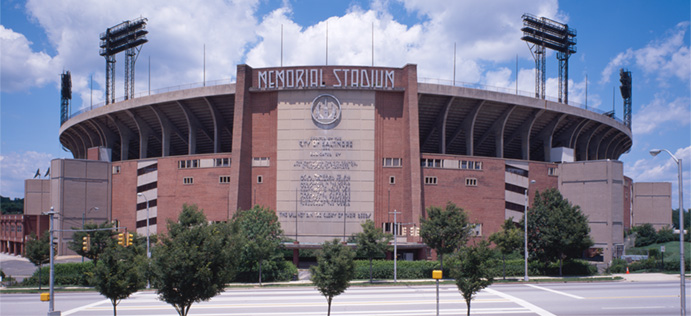
(Library of Congress)
The perfect postwar neighborhood ballpark, Memorial Stadium was a towering tribute to fallen soldiers on the outside and a beholding of green on the inside with its sparkling field, tree-lined perimeter and verdant streets of row houses beyond. Embraced by pitchers and defenders, excoriated by home run hitters, Memorial was the beacon that gave Baltimore the major league status its residents so long craved.
When folks walked toward the main entrance of Memorial Stadium for the first time, they could not shake off the commanding, almost intimidating façade that greeted them. The resolute frontage, rising high above the rest of the venue’s bowl, flanked by protruding brick red columns and topped by unique deco-style titling, was a visual bullhorn for incoming fans to remind them of the ultimate sacrifice made by Baltimore-raised military servicemen.
Once inside, Memorial Stadium’s structure was common and drab, clearly lacking the bells and whistles that its successor, Oriole Park at Camden Yards, would later be drenched in. But Memorial’s bland appearance would be greatly offset by the lively personality of the fan base that inhabited it. The Chicago Tribune didn’t hesitate, in 1959, to brand Memorial Stadium as “the world’s largest outdoor insane asylum.”
“There was a certain amount of raucousness and rowdiness that possessed Orioles fans,” said lifetime Baltimore resident Paul Schlitz, who bore witness to nearly the bulk of Memorial Stadium’s timespan. “No seat was located very far from a funny drunk. They were brutal to the other team—particularly the third base and first base coaches. But they were legitimately funny!”
For all their zaniness, Orioles fans probably had nothing on those of the Colts, who arrived in Baltimore a year before the Orioles and were, admittedly, the big team in town until owner Robert Irsay wrecked the organization in the 1970s and notoriously fled Maryland for Indiana in the middle of a snowy 1984 night. Playing in a stadium whose horseshoe shape mirrored that of their helmet logo, the Colts housed fans of all shapes, sizes and levels of sanity.
One spectator was fool enough to run onto the field during a 1970 game and take off with the football, only to be flattened by Colts linebacker Mike Curtis. Another “fan,” irate at a Colts player who threw him out of a bar, was crazed enough to fly his Cesena into the upper deck of Memorial Stadium moments after a 1976 playoff game. Astonishingly, the pilot suffered only minor injuries, as did a handful of fans; the potential for mass carnage might have been much higher had the game—a 40-14 blowout by the opposing Pittsburgh Steelers—not emptied the stadium out earlier. The rabidness of Colts fans was exaggerated, perhaps, in the 1982 film Diner when a young Baltimorean played by Steve Guttenburg gave his fiancée a lengthy quiz on Colts trivia; if she didn’t pass the test, the marriage was off.
Amid the rise-and-fall reign of the Colts, baseball remained the steady constant at Memorial Stadium, even in the evolutionary years of the facility—before its completion as a place remembered by millions of ticketholders.
The Agonizingly Long Pursuit of Traction.
Many of Baltimore’s early major league ballclubs—and the ballparks they inhabited—seemed to come and go at a rate to rival the changing of the seasons. Here-today, gone-tomorrow franchises included the Canaries and Marylands of the National Association, and the Monumentals of the one-year Union League; in the years to follow, more promising big-league entries were practically cut down in midstride. The National League’s Orioles, a dynasty of the mid-1890s, became a surprise victim of contraction in 1899. The first iteration of the American League’s Orioles was decimated and disbanded as a result of rival NL sabotage in 1902. And the Federal League’s Terrapins got such a raw deal in the short-lived (1914-15) circuit’s peace settlement with the NL and AL, they sued on antitrust grounds. That case would last seven years and make its way up to the U.S. Supreme Court—which ruled against the Terrapins and, adding a middle finger, gifted baseball with its antitrust exemption.
The most resilient of Baltimore baseball clubs before the building of Memorial Stadium were the minor-league Orioles, who ascended to powerhouse status during the 1920s with seven straight International League titles while acting as a virtual farm club for the Philadelphia Athletics, giving them first dibs on star Orioles talents such as future Hall-of-Fame ace Lefty Grove. (Babe Ruth was also offered to the A’s, but owner Connie Mack didn’t have the money at the moment.)
After the Terrapins’ demise in 1915, Orioles lord Jack Dunn bought the FL team’s ballpark for $25,000 and renamed it Oriole Park. Seating roughly 15,000, Oriole Park hosted not only the Orioles but, for a brief time starting in 1939, the Negro National League’s Baltimore Elite Giants, which included within its roster Hall-of-Fame catcher/manager Biz Mackey and his backstop protégé, a teenage Roy Campanella.
The Orioles’ occupancy at Oriole Park came to an abrupt end on the Fourth of July, 1944, when a fire swept through the entire ballpark. If only Francis Scott Key was there to pen a patriotic song about it, over a century after writing The Star-Spangled Banner in Baltimore during the War of 1812.
Seeking emergency shelter, the Orioles found it at Baltimore Municipal Stadium, a football-shaped venue built in 1922 that featured a Romanesque entry façade and not much else—with no scoreboard, seatbacks, or grandstand roof to protect fans from rain or the hot sun. Awkwardly squeezing a baseball field into an oval, a la the Los Angeles Dodgers with the Memorial Coliseum from 1958-61, made playing conditions dubious for ballplayers—but winning momentarily sidelined the complaints, as the Orioles triumphed in 30 of their 39 games at Municipal Stadium to finish the regular season. More interestingly, the fans started showing up; after drawing 99,000 in 26 games at Oriole Park, the Orioles attracted 500,000 over 37 dates at Municipal.
The crowds only swelled from there, with a then-minor league-record 52,833 showing up for a Junior World Series game against the Louisville Colonels, won by the Orioles; sportswriters were quick to point out that the gathering easily outnumbered the (albeit capacity-filled) crowds for the all-St. Louis World Series going on at the same time in Sportsman’s Park. Regardless, the mass turnout at Municipal Stadium proved that Baltimore was, this time, definitely, ready for big-league ball.
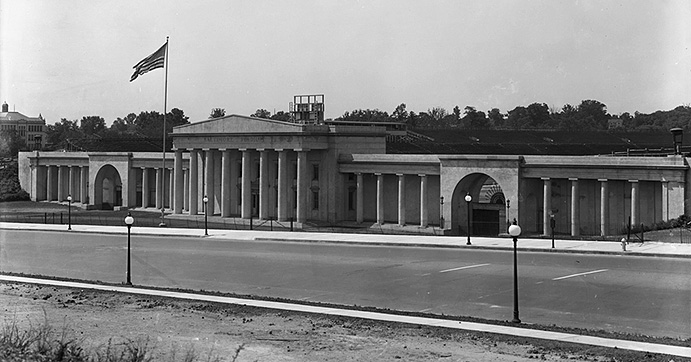
Channeling Chicago’s Soldier Field and the Parthenon in Greece, this was the entry façade for Municipal Stadium, built in 1922 on the site where it would later be transformed into Memorial Stadium. (Maryland Center of History and Culture)
The Long, Slow Build.
Civic leaders began moving on an effort to build a multi-purpose venue that would attract both major league baseball and pro football. Among the first and most audacious ideas came from local aircraft builder Glenn L. Martin Company, which proposed a 100,000-seat facility with a thin metal roof raised up by air, a concept not lost on Minneapolis residents who frequented the Metrodome decades later. However a new stadium would appear, the chatter intensified that it should replace Municipal Stadium and its complete lack of comfort and frills.
Change would come and Municipal Stadium would transform into Memorial Stadium, but the process would be evolutionary, not overnight. In the Spring of 1947, area voters said yes to a $2.5 million loan to build the replacement, but the city wanted to double down and ask for another $2.5 million a year later to fulfill the idealized scope of the rebuild; this time, the voters were not as keen and rejected the measure. In 1950, the city tried again, hoping (or begging) to convince citizens that the extra money was a critical tipping point to lure major league sports. The persuasion worked, with voters narrowly nodding for the affirmative.
As the money came through in piecemeal fashion, it was only natural that the rebuild would proceed at a similar pace. The initial funds went toward reinventing the structure into what would become Memorial Stadium’s lower deck, which included eight towers of lights—two of them planted on the field, in foul territory just past the coaches’ boxes. (As if infielders needed another obstacle to deal with, there it was.) Meanwhile, controversy swirled around the ballpark’s name; veterans groups had assumed it would be called Memorial Stadium, and got heated when officials in 1949 decided to go with Babe Ruth Stadium, named after the Baltimore-born legend of lore who had recently passed away. Before the year was out, the vets’ outshouting of the politicos got the latter group to change its mind and revert back to Memorial.
It wasn’t until 1953 that work on the upper deck began, a belated stage of construction due to rising prices and materials shortages owing to the Korean War. Because of the situation, a grandstand roof would not be applied to the upper level—leaving Memorial Stadium, at the time of its opening, as the only major league ballpark without any upper-deck shade. Surviving from the blueprints was a small, seven-row middle deck, which could have been confused by modern-day witnesses for luxury boxes, and a $172,000 scoreboard. Beer would be allowed to be sold, to the consternation of many churchgoers who protested the idea to the Maryland Liquor Board—though they did gain one small victory as sales of the suds would be restricted to the concourses, not within the aisles from roaming vendors.
Municipal Stadium’s Parthenon-like façade would stick around until 1954, when it was replaced by the towering “Memorial Wall” that would greet Memorial Stadium spectators for the next four decades to come. At 116 feet tall, it could have been labeled the Amazing Colossal Plaque. The unique, stainless-steel Art Deco typography, designed and personally hand-cut by Francis Tarlowski, was connected along with the City of Baltimore seal to a cast stone wall; its inscription read, “Dedicated as a memorial to all who so valiantly fought in the world wars with eternal gratitude to those who made the supreme sacrifice to preserve equality and freedom throughout the world—time will not dim the glory of their deeds.” Serving as a tribute to Baltimore veterans who gave their lives in both World Wars and the Korean conflict, the wall was formally dedicated in 1956—two years after the rest of the ballpark was completed—adding a glass-encased brass urn that included soil from every U.S. military cemetery outside of the country.
Look Who’s Coming to Baltimore.
As the conversion from Municipal Stadium to Memorial Stadium neared completion, the question persisted: Which major league team was going to fill it? For Baltimore officials, the primary target was the St. Louis Browns, a postwar mess of a team, losing relevance in a city increasingly turning Cardinal Red. As early as 1947, rumors spread of Baltimore business leaders attempting to buy the Browns, but the first concrete sign came in 1953 when maverick owner Bill Veeck, who had purchased the Browns two years earlier, asked the American League for permission to move the team to Baltimore. Six of the other seven AL owners rejected him—saying that Veeck lacked sound financial backbone, though in truth they hated Veeck and his Barnum & Bailey method of promotions.
So certain of getting the shift approved that he had already printed Opening Day tickets in Baltimore, Veeck was forced to stick it out one more season in St. Louis before crying uncle and selling the team; the new ownership group quickly got the AL’s blessing to relocate to Maryland.
People in Baltimore were absolutely giddy over the arrival of the Orioles-nee-Browns and big-league ball. (The minor league Orioles departed for Richmond, Virginia.) Three months before Opening Day, more advanced tickets had already been sold for the Orioles’ first season than what the Browns drew for their entire last season in St. Louis. Team officials encouraged Baltimoreans with a campaign entitled “Beat Milwaukee,” in hopes of surpassing the 1.826 million fans drawn by the 1953 Braves, in their first year after relocating from Boston. Orioles president Clarence Miles lamented to The Sporting News: “If our drive to sell two million tickets fails, it will be a sad day for this town.”
The Orioles’ first game at Memorial Stadium certainly gave promise of a popular, well-attended tenure to come. A virtual holiday was declared in Baltimore, with all schools closed; the game was preceded by a parade featuring 30 orchid-filled floats, attended by half a million people on a route connecting City Hall to Memorial Stadium. Inside the ballpark, 46,354 more fans including Vice President Richard Nixon (throwing out the ceremonial first pitch) crammed in to watch the Orioles defeat the Chicago White Sox, 3-1, behind a complete-game effort from pitcher Bob Turley and solo home runs from Clint Courtney and Vern Stephens.
While the fans were ready for the Orioles, Memorial Stadium still had some catching up to do. Three of nine pedestrian ramps remained unfinished to the upper deck, which itself was barely completed in time for Opening Day. Portable ticket booths were used while the permanent ones were still being readied. An elevator to the press box, along with a sportswriters’ lounge, had yet to be installed. And a whole new lighting system wasn’t fully operable until July, leaving Memorial as a temporary daytime-only facility. (The light towers planted smack in the middle of foul territory were removed.)
It was a bittersweet first season for the Orioles. They surpassed the Browns’ all-time St. Louis attendance mark (712,000, from 1922) at the season’s halfway point, but by year’s end fell well short in their quest to “Beat Milwaukee,” selling 1,060,910 tickets. Winning would have helped; while the 1953 Braves became instant contenders, the 1954 Orioles still played like the pitiful ol’ Browns, posting the same dismal record (54-100) as the previous season in St. Louis.
“That Fence That’s About Nine Miles Away.”
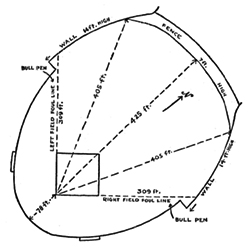
This 1956 Sporting News diagram shows Memorial Stadium’s field dimensions after the Orioles brought in the fences between the gaps. The gaps were originally a whopping 450 feet from home plate; if that wasn’t enough work for center fielders, note how they would need to be ready to react to any ball ricocheting off the wall near the foul pole, redirecting straight at them.
Any ball hit off the sharply receding wall between the foul pole and gap wouldn’t ricochet back toward the infield but, more likely, directly toward center field. The basic meaning: A deep fly, whether hit toward center or near the foul poles, would force the center fielder to be on his toes and ready to be a part of the moment. The mixture of the spacious outfield and unorthodox rebounds resulted in more triples (55) than home runs (42) during the Orioles’ first year at Memorial.
After another futile season of slugging misery, Memorial Stadium’s fences in 1956 were brought in to still spacious (but less insane) dimensions, with the gaps at 405 feet and center field at 425; two years later, they were moved in again to, respectively, 380 and 410. Rocky Colavito was grateful; in 1959, the Cleveland Indians boomer socked four home runs at Memorial, but left with a sarcastic note: “Every time I come here it’s a wonderful feeling except for that fence that’s about nine miles away.”
In 1961, the Orioles’ Jim Gentile launched 46—but only 16 of those were belted at Memorial Stadium. Even when, a year later, the fences were brought in once more at the gaps (down to 370 feet)—which would have given Gentile a fighting chance for power equilibrium between home and the road— he still only managed to collect 10 of his 33 total homers at Memorial. “I’m tired,” Gentile at one point deadpanned to reporters during that season, “and I don’t like the park.”
None of Memorial Stadium’s outfield configurations could hold in some of the venue’s longest pops. In 1962, Orioles rookie Boog Powell crushed the first ball ever hit over the 10-foot hedge beyond center field, landing 469 feet away from home plate. Harmon Killebrew had Powell beat two years later when he smoked what’s considered the longest homer in Memorial history, at 475 feet. But the one Orioles fans remembered the most took place early in Frank Robinson’s triple-crown season of 1966, when he drilled a pitch from Cleveland’s Luis Tiant that sailed completely over the left-field bleachers and out of the stadium. Never mind that the ball officially traveled less (451 feet) than those hit by Powell and Killebrew; the optics of it leaving the building resonated more with the fans. The Orioles planted a pole at the point where Robinson’s tape-measured shot cleared the last row, with a flag atop it simply stating, “Here.” It remained standing through the Orioles’ very `last game at the ballpark in 1991.
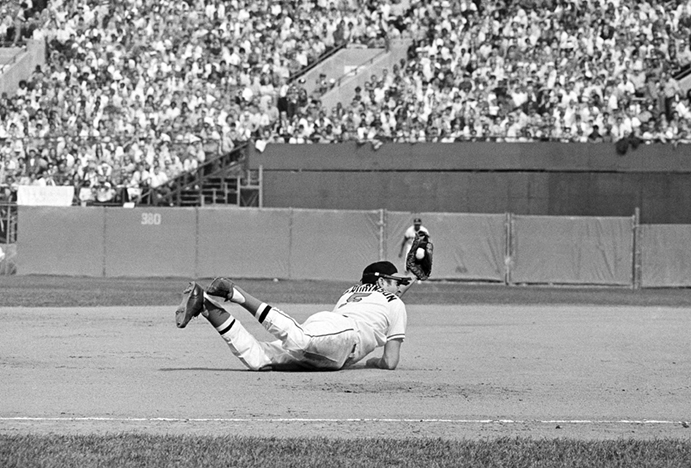
Undoubtedly the most popular player during the Orioles’ tenure at Memorial Stadium, third baseman Brooks Robinson makes a diving stab at a sharp grounder during the 1970 World Series. Robinson lists as #1 in most career offensive categories at Memorial; he also ran a restaurant in the neighborhood. (Associated Press)
Neighborly Love and Hate.
Some might have found romanticism in a ballpark’s setting amid a quasi-suburban community largely consisting of quaint row houses. But there’s a sketchier truth in Memorial Stadium’s relationship with the residents who surrounded it.
There certainly was appeal for those who worked at Memorial to live near it. The home of Eddie Rommel, who umpired the ballpark’s first major league game in 1954, sat just five minutes away by foot; he walked to the gates. Popular Orioles stars of the 1960s, including Brooks Robinson, Boog Powell and Dave McNally, lived within walking distance as well. For Robinson, the popular Hall-of-Fame third baseman who played 23 years at Memorial Stadium and produced more hits (1,397) and Gold Gloves (16) there than anyone else, connected with the locals through more than just a home address; he also ran a favored neighborhood restaurant along with brief teammate Eddie Robinson (no relation).
While many neighborhood residents embraced Memorial Stadium and the teams that played there, seemingly just as many others would rather have done without it. Traffic was one issue, as four- and (mostly) two-lane streets were clogged before and after games with no major thoroughfares nearby to speed things up. Even before the Orioles’ arrival from St. Louis, the neighborhood NIMBYs were already complaining of the discomforting side effects which the minor-league Orioles had brought to the stadium—knowing it would only get worse with a bigger facility hosting major league sports. Opposing sides lawyered up, and middle ground was reached with games not allowed to go late into the night, paved parking lots (as opposed to the dirt ones kicking up a dust storm), and a quieter public address system.
In later years, with the big-league Orioles and NFL Colts having arrived at Memorial, many residents decided that if you can’t beat ‘em, make money off ‘em—charging arriving fans for driveway parking spots and sidewalk perishables.
Keeping Up with the Robinsons.
Through Memorial Stadium’s first 15 years, modest changes and upgrades were made. In 1961, eight rows were added at the front of the field level, increasing capacity by over 2,500 and decreasing the distance from home plate to the backstop by 20 feet, down to 60. (Interestingly, the reduction in foul territory didn’t improve overall batting averages, as is usually assumed with such a move.) This also necessitated the need for new dugouts, which included air conditioning—but only for the Orioles on the third-base side. A year later, in 1962, a voter-approved $1.2 million package allowed all seats on the lower level to be furnished with seatbacks, while escalators were added to accommodate those finding it tough to climb up the steep upper deck.
The latter addition became a source of tragedy on May 2, 1964 when, on a day ironically tabbed as School Safety Day, one of the escalators malfunctioned and restricted access to the top. That forced a large group of kids to reverse course and run back down—causing a crush at the bottom. One girl died while 46 others were injured.
As Memorial Stadium improved, so did the Orioles. In their seventh year at Baltimore, the Orioles finally shed the skin of the futile Browns before them and enjoyed their first winning record in Maryland, finishing a distant second to the New York Yankees. By 1966, they became a powerhouse—winning the franchise’s first-ever world title in a four-game sweep of the Dodgers, before grabbing another trophy four years later under the fiery managership of Earl Weaver, whose bulldog-like temperament kept everyone around him on their toes. Through the mid-1980s, the Orioles would be consistent contenders at Memorial Stadium, suffering only two losing records over a 25-year period.
The Orioles were graced by many icons through this impressive period. The aforementioned Brooks Robinson, who dominated Memorial’s all-time leaderboards, found his pitching equivalent during the mid-1960s in Jim Palmer, the suave, erudite and outstanding (three Cy Young Awards) ace whose 134 wins at Memorial were the most of any pitcher. (Proving his dominance away from the ballpark, Palmer also won 134 on the road.) Despite his relatively brief time at Baltimore, Frank Robinson is fondly remembered by Orioles fans for his triple-crown performance—leading the AL in batting average, home runs and RBIs—which put the Orioles over the top with their 1966 World Series-winning campaign. Eddie Murray, as consistent an All-Star presence as could be found, featured as Baltimore’s slugger over his first dozen years, bashing more home runs (160) at Memorial than any other player. And in his rookie 1982 campaign, shortstop Cal Ripken Jr. did not make the starting lineup in two early games—but didn’t miss another through the rest of Memorial’s baseball existence, building a streak of consecutive games that threatened Lou Gehrig’s seemingly unbreakable all-time mark—while winning two MVPs and guiding the 1983 Orioles to their last world title at Memorial.

A view of the upper-level concourse at Memorial Stadium. Beyond the usual ballpark fare, the favorite offering among Orioles fans was crab cakes. (Library of Congress)
Fields of Green (At Least Until October).
Whether they were All-Stars or common players, most anyone who wore an Orioles uniform at Memorial Stadium gave high praise to the ballpark’s groundskeeper, Pat Santarone. Overseeing the turf for the Orioles’ final 23 years at Memorial, Santarone became a player’s favorite with an immaculate field; Mark Belanger, who played all but one of his 18 big-league seasons at Baltimore and won eight Gold Gloves at shortstop, said that it was a “pleasure to field in our park.”
Santarone also developed a solid friendship with Earl Weaver; when Santarone put up a tomato garden behind a retainment wall near the left-field corner, he’d engage in a yearly competition with Weaver as to which one could grow the largest tomato.
The biggest challenge for Santarone came in the fall, when the schedules for both the Orioles and Colts overlapped. It was particularly problematic during the 1970s, when the Orioles’ season frequently extended into October while the Colts chewed up the field every other weekend. (Also not helping during this time were abundant summer rains, a failed pro soccer franchise and concerts that allowed spectators on the field.) During the 1971 World Series, legendary outfielder Roberto Clemente of the opposing Pittsburgh Pirates deplored the conditions of Memorial’s field as the worst he’d ever played on. “I don’t worry about (losing),” he said. “But I just want to get out of this ballpark.”
Conditions got so bad that by late December, when the Colts hosted playoff games, the field basically became nothing more than dirt with chalk markings. It was no wonder that the Colts intermittingly lobbied, albeit unsuccessfully, for artificial turf to be placed at Memorial Stadium.
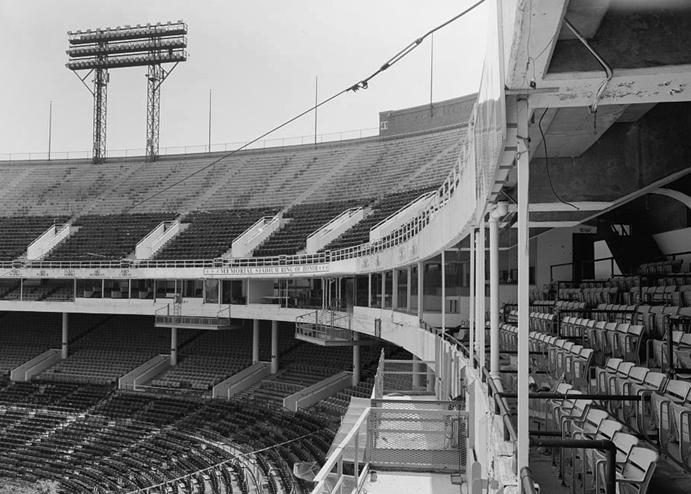
A view from the small middle deck of Memorial Stadium, consisting of press facilities and spectator sections seven rows deep. This image was taken after the last events were held at the ballpark; it sat empty and decaying until 2001, when demolition finally began. (Library of Congress)
Is There Anybody Out There?
In a 13-year span starting with their 1966 world championship season, the Orioles won more games than any other MLB team—yet annually struggled to draw a million fans at the gate. Five times over that stretch, they didn’t make it there. All this, despite the fact that Memorial Stadium was among the most affordable ballparks to visit with relatively inexpensive tickets. An expected bump at the gate in the early 1970s with the neighboring Washington Senators departing to Texas—giving the Orioles a major league monopoly over the greater Beltway market—failed to materialize.
Not even the lure of postseason play failed to generate what one would assume to be automatic sellouts. Empty seats, sometimes whole swaths of them, were a frequent sight at Memorial in October—with barely half the ballpark filled for some American League Championship Series contests.
With Orioles ownership increasingly frustrated, the City of Baltimore lit a fire under itself to see what it could do to further improve Memorial Stadium, which barely 20 years after its opening was already getting tagged with labels such as “old” and “outdated.” In 1969, the city hired a New York consulting firm to whip up three options for an upgrade, ranging from the touch-up to the overhaul; the latter option called for a “loge” level much like the second deck at Los Angeles’ Dodger Stadium, as well as a restaurant. Three years later, another firm—this one from Seattle—came up with some of the same ideas, adding a 12,000-car parking garage which was received from surrounding residents with a firm shaking of the head. About this same time, the first echoes of chatter began on the concept of building side-by-side facilities for the Orioles and Colts at Camden Yards.
All the architects’ renderings and cocktail napkin sketches never came to fruition; money and constant disagreements on the finer details between the Orioles, Colts and the city led nowhere. Upgrades that were done were modest at best, and included the replacing of wood benches with aluminum ones and a new scoreboard that would immediately be plagued with mechanical issues. The city kept needling the Orioles for a new long-term lease, but the team wanted nothing more than a couple of years—often with a clause, unused, that the team would be free to play a small percentage of its home games outside of Baltimore, the likely target being Washington. The Orioles never seriously considered a move out of Baltimore; they just wanted something in the lease that would keep the city on edge.
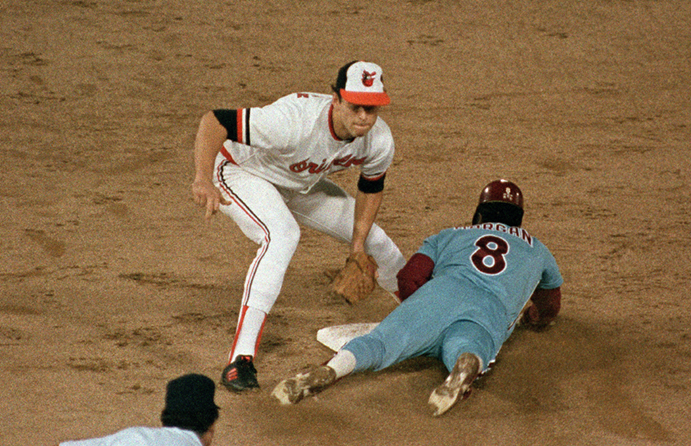
The Orioles’ Cal Ripken Jr. attempts to tag out Philadelphia’s Joe Morgan during the 1983 World Series at Memorial Stadium. Ripken played every game at the ballpark from early 1982 through its closing in 1991, running his overall streak of consecutive games played to 1,595; he would eventually break Lou Gehrig’s legendary streak seven years later, playing in Oriole Park at Camden Yards. (Associated Press)
Bigger and Crazier Than Ever.
Finally, in 1979, the Orioles experienced an attendance boom, drawing nearly 1.7 million—roughly half a million above their previous record gate. Yes, winning the AL pennant played a sudden role in the rise, but that’s something the Orioles had previously done four times without attendance shooting up. What changed wasn’t so much that Baltimore sports fans had found the Orioles, but that the Colts had lost the fans.
Robert Irsay—who basically swapped his Los Angeles Rams in 1972 for Carroll Rosenbloom’s Colts—had, with each passing year in Baltimore, made a bigger mess of the organization. He alienated coaches, players and the fans with constant meddling and kneejerk decisions (almost all of them bad); he also wanted nothing to do with Memorial Stadium anymore, adapting a far more hostile stance than the Orioles toward the city. Colts fans, once immensely loyal to their team, began to switch off; once a sure sellout at Memorial Stadium, the Colts by 1980 found themselves playing before crowds as sparse as 16,000—an embarrassment by NFL standards. As the Colts’ attendance collapsed, it thus mushroomed for the Orioles.
Among the spectators shedding Colts blue-and-white for Orioles black-and-orange were those who could definitely be confirmed as certifiable. One of the more good-natured of those fans was “Wild” Bill Hagy, a long-haired, bearded, pot-bellied cab driver with a country hat who would get in front of the crowd and contort his body to spell out O-R-I-O-L-E-S. Hagy first started his chant in Section 34 of Memorial Stadium’s upper deck, and eventually was allowed to do his thing on top of the Orioles’ dugout; he kept the routine going through the mid-1980s, then stopped because he tired of it—plus, he no longer was allowed to bring beer into the ballpark.
Other “fans” weren’t as friendly. One ran onto the field in a 1980 game and tried to take off with the cap of Orioles pitching coach Ray Miller; when Miller resisted, he was punched him in the face. Another intruder was chased by security through the field, trampling through Mike Santarone’s tomato garden. A 19-year-old fan climbed to the top of one of the light towers behind the outfield; he wasn’t even noticed until late in the game, when he was brought down and arrested. Others snuck onto the field in the middle of a night and used kerosene and charcoal to sear the infield grass with “SOX SUC.” Santarone had to erase the message by chewing up the grass around it. “I never thought I would intentionally desecrate infield grass,” he said. “It makes me sick.”
Attendance for the Orioles at Memorial Stadium continued to grow throughout the 1980s, as the team found themselves the venue’s sole tenant after the Colts’ graveyard-shift departure to Indianapolis in 1984. The Orioles drew two million for the first time in 1983—winning their third and last World Series at Memorial—rising to the 2.5-million threshold in each of their final three seasons (1989-91) at the ballpark. Loyalty to the Orioles became so strong, fans sold out Memorial early in 1988 to welcome back a ballclub returning from a 12-game road swing and a disastrous, record-smashing 0-21 start; the team rewarded them with a 9-4 victory over the Texas Rangers, only their second win of the season in 25 attempts. Just three days later, the Orioles signed a 15-year lease to play at Oriole Park at Camden Yards, still over a year away from its groundbreaking ceremony.
Despite its lame-duck status, Memorial Stadium continued to be improved. For the players, a state-of-the-art weight room and batting cage were installed under the stands. For the fans, the concession menu expanded with the majors’ first-ever Kosher food stand, though the longstanding Memorial tradition of crab cakes remained the top choice. Along with the loyalty came the royalty; in Memorial’s 38th and final season housing the Orioles, the red carpet was rolled out for Queen Elizabeth II, accommodated by President George H. Bush. Orioles pitcher Dave Johnson—not to be confused with one-time Baltimore infielder and later manager Davey Johnson—displayed yawns over awe at the special guest. “It’s not like she was elected or anything,” Johnson said, “It was like, bam, you’re born, you’re queen.”
On October 6, 1991, the Orioles played their final game at Memorial Stadium. Arriving fans were greeted by Orioles legends, who said hello, shook hands, and gave out 1992 calendars of the new Camden Yards ballpark. The celebrity ushers included Earl Weaver, the long-since retired, yet still touchy, Orioles manager who struggled to break character and put on a happy face. The National Anthem was played by the Baltimore Colts’ Marching Band, which stuck around and remained a thing nearly a decade after the Colts’ departure. The opposing Detroit Tigers won, 7-1, with pitcher Frank Tanana going the distance; Cal Ripken Jr., capping his second MVP season, grounded into a double play to end big-league baseball at Memorial Stadium.
The real treat came after the final pitch. Unbeknownst to the sellout crowd of 50,700, 75 former Orioles players, from Brooks Robinson to Frank Robinson to Jim Palmer, trotted out and took their places in the parts of the field for which they once held sway. Weaver was the last to come out, walking to home plate and kicking dirt at an imaginary umpire. The faux anger quickly turned to true tears, as Weaver began to cry at the moment. Lastly, there was a video of long-time public address announcer (and former pitcher) Rex Barney, in a hospital bed recovering from a bout of dizzy spells, shouting out his trademark outro, “Thank yoooou…”
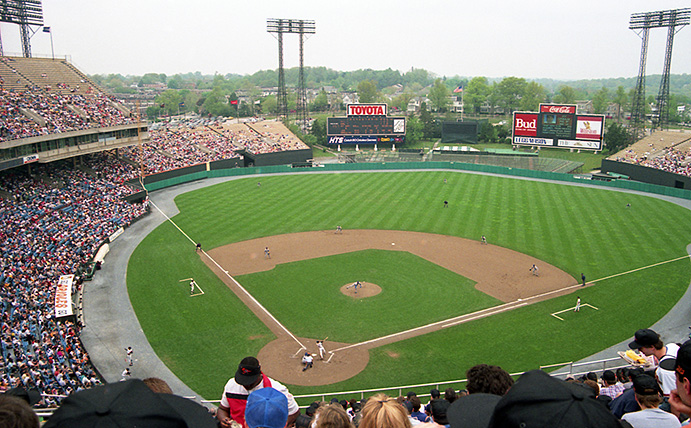
Inside Memorial Stadium, during the Orioles’ last season at the ballpark in 1991. After the team’s departure, the venue stayed active with a mix of football teams over the next six years. (Flickr—Paul)
Cameos as Coda.
After the Orioles’ departure, Memorial Stadium managed to stay active. Football returned, in many forms. The University of Maryland hosted Penn State late in 1991 before a sellout crowd. From 1994-95, the Baltimore Stallions called Memorial home during the Canadian Football League’s ill-fated, thus short-lived, attempt to expand into America, averaging a decent 30,000 fans per game. And in 1996, the second pro sports team nicknamed the Browns relocated to Memorial Stadium, as the NFL’s Cleveland Browns resettled in Baltimore, rebranded themselves as the Ravens, and made temporary use of Memorial before moving on to what is now M&T Bank Stadium, roughly two blocks from Oriole Park at Camden Yards.
There would even be more baseball at the Old Gray Lady of 33rd Street. In 1993, the minor league Bowie Baysox made Memorial Stadium their home while a new ballpark was being built; they drew 254,000 spectators over 70 games.
The curtain finally came down on Memorial after the Ravens’ last game of 1997. The venue sat idle, unused and neglected as it awaited its fate. Weeds grew tall within the giant ghost. There was discussion on whether Memorial could be preserved by being placed on the National Register of Historic Places, but that chat simmered when it was revealed that it would cost three times as much to resurrect the facility than to demolish it. Beginning in 2001, Memorial’s grim reaper—in the guise of a wrecking ball—showed up to begin the knocking down of the structure. Left standing was the memorial wall façade at the main entrance, given life support as neighborhood residents debated whether to let it stay. They eventually said no.
The phrase at the bottom of the memorial wall—“Time will not dim the glory of their deeds”—was reapplied to a curved granite display outside of Oriole Park at Camden Yards, accompanied nearby with a laser-cut image of Memorial Stadium and the glass-encased urn of cemetery soil once displayed inside the venue’s entry area. Ripken Stadium, a minor-league ballpark in Aberdeen, Maryland, tried to get the large “Memorial Stadium” letters on the façade, but it never materialized. Those letters reportedly remain somewhere in storage.
Concrete remains of Memorial Stadium were dumped into Chesapeake Bay to create an oyster reef, making it the third sports facility (after Cleveland’s Municipal Stadium and Jacksonville’s Gator Bowl) to be dumped in the water to regenerate aquatic life.
Today, the real estate that Memorial Stadium once sat on is a spacious, mixed-use development mostly devoted to senior living, with park space peppered here and there. In the middle is an oval recreation area containing a field with markings for both baseball and football/soccer—the exact same location as those used for Memorial Stadium. Sixty thousand seats are gone, having given away to a handful of petite Little League-style bleachers. The Memorial Wall is gone, replaced by a memorial plaque one can comfortably carry in the back of an SUV.
Some 75 years after Memorial Stadium’s opening, the neighborhood reigns—but so do the memories for those who come, sit back, and watch young kids hoping to emulate the moves of Brooks Robinson and Johnny Unitas.
 The Ballparks: Oriole Park at Camden Yards To say that nostalgia was at the forefront of those behind Oriole Park at Camden Yards is the understatement of yesteryear. The Baltimore Orioles went back to the city, to the very spot where Babe Ruth’s father used to serve drinks, and built a baseball fortress unlike anything seen since Ebbets Field met the wrecking ball. They even rethought the overlong and ancient B&O Warehouse behind right field, embracing rather than destroying it—thus transforming urban blight into trendy atmospherics.
Baltimore Orioles Team History A decade-by-decade history of the Orioles, the ballparks they’ve played in, and the four people who are on the franchise’s Mount Rushmore.
Memorial Stadium: The Basic Facts
Tenants
Baltimore Orioles (International League), 1950-53 Baltimore Elite Giants, (Negro American League), 1950 Baltimore Colts (AAFC/NFL), 1950 Baltimore Colts (NFL), 1953-83 Baltimore Orioles, 1954-91 Baltimore Bays (NPSL/NASL), 1967-68 Baltimore Comets (NASL), 1974-75 Bowie Baysox (Eastern League), 1993 Baltimore Stallions (CFL), 1994-95 Baltimore Ravens (NFL), 1996-97Location
900 East 33rd Street, Baltimore, MarylandDate of Approval
May 1947Date of Groundbreaking
1949Date of Groundbreaking
April 2001-February 2002Cost
$6.5 millionCapacity (Final)
53,371Field Dimensions (Final)
Left field line: 309 feet Left-center field: 376 feet Center field: 405 feet Right-center field: 376 feet Right-field line: 309 feetFirst Game (MLB)
April 15, 1954 Baltimore Orioles 3, Chicago White Sox 1Last Game
October 6, 1991 Detroit Tigers 7, Baltimore Orioles 1First Hit
Chico Carrasquel (single)Last Hit
Cecil Fielder (single)First Home Run
Clint CourtneyLast Home Run
Chito MartinezFirst Win
Bob TurleyLast Win
Frank TananaPerfect Games
NoneNo-Hitters
September 20, 1958—Hoyt Wilhelm April 30, 1967—Steve Barber (8.2), Stu Miller (0.1) April 27, 1968—Tom Phoebus August 13, 1969—Jim Palmer April 15, 1987—Juan Nieves August 11, 1991—Wilson AlvarezLongest Home Run
471 feet—Harmon Killebrew, May 24, 1964Highest Attendance, Season
2,552,753—1991Lowest Attendance, Season
774,343—1963Best Home Record
60-21—1969Worst Home Record
31-51—1987All-Star Games
1958—American League 4, National League 3Bet You Didn’t Know…
The St. Louis Browns—the team that would move to Memorial Stadium and become the Orioles—actually played their first game at the ballpark on August 20, 1953, a year before their permanent relocation to Baltimore. They defeated the minor league Orioles in an exhibition, 8-2, before a crowd of 10,681 while the upper deck was being constructed.
The New York Yankees were the only team to score 20 runs in a game at Memorial Stadium, defeating the Orioles in the second game of an August 14, 1955 doubleheader, 20-6.
The lone All-Star Game held at Memorial Stadium, in 1958, was the first (and still, only) one that didn’t include an extra-base hit, with 13 singles and nothing else in the American League’s 4-3 victory.
Few people got along with Joseph Hughes, whose company was Memorial Stadium’s prime contractor. Hughes publicly chastised officials and architects during the building of the venue, once calling out the steep upper deck as something “fans will need sky hooks to hold on to.” At one point after the ballpark’s completion, Hughes put padlocks on all of the concessions stands before a game, claiming the concessionaires wouldn’t pay him for what they described as inadequate work. Baltimore’s finest had to come out and cut off the locks.
A 300-pound freezer that was to be gifted to Orioles third baseman Brooks Robinson was somehow stolen out of Memorial Stadium two days before a 1964 pregame ceremony in his honor. The Orioles had to run around to scrounge up another.
Robinson was also instrumental in working with Memorial Stadium staff to give him some advantages. He insisted on having the grounds crew not water down the area around third base because he preferred the dirt to be hard; in the late 1960s, Robinson also requested that some of the light bulbs in the AL standings board behind the outfield fence be painted black (thus darkening them) so he could see pitches from a left-handed pitcher better.
Hoyt Wilhelm loved Memorial Stadium. The Hall-of-Fame knuckleballer threw the ballpark’s first no-hitter in 1958, had the best career ERA (2.38) by an Orioles hurler with a minimum of 250 innings logged, and had the lowest (0.63) as an opponent regardless of the number of innings thrown.
Despite hitting only .231 in 135 games at Memorial Stadium, Harmon Killebrew hit the most home runs among visitors with 30. One of them was the longest in the ballpark’s history.
John Denver’s Thank God I’m a Country Boy was played during the seventh inning stretch from 1975-87. It was suggested by Orioles shortstop Mark Belanger, who thought the song’s energy would put fans in a good mood for the remaining innings—all despite the fact that nothing said “country” less than Baltimore. The use of the song was stopped by new owner Eli Jacobs for 1988, but resumed at Oriole Park at Camden Yards in 1993 (and ever since) after he sold the team.
Before a 1978 game, the Rangers’ Doc Medich—in the process of completing his medical training at the University of Pittsburgh—went into the Memorial Stadium stands before a game and administered CPR to a 61-year-old fan who had suffered a heart attack and had no pulse. Medich was able to revive the man and keep him alive until paramedics arrived. The fan was rushed to the hospital and ultimately recovered. (If this sounds familiar, Medich did the same exact thing before a game in Philadelphia two years earlier; alas, in that case, the fan died.)
No statues were ever planted in or around Memorial Stadium. There was an effort in 1981 to have sculptures depicting Brooks Robinson and legendary Colts quarterback Johnny Unitas created, but a campaign to raise $90,000 fell sort.